To support the development of my Urban Arts app, I carried out research into existing art gallery websites and apps, as well as user expectations and accessibility considerations. I looked at a range of gallery platforms, including Tate Modern, to understand how they present exhibitions, artists, and visitor information. I found that most gallery apps use a minimal design style, with clear navigation and large images to highlight the artwork. However, I also noticed that some platforms feel overly complex, with too many menus or unclear navigation systems, which can make the user experience confusing.
In addition to this, I explored secondary research by analysing visitor feedback on Google Reviews for galleries. Specifically for the Tate Modern app, there was a lot of people complaining about the navigation of the app, and that it was a ‘giant advert of nonsense’ via the reviews of the Tate Modern app store reviews.
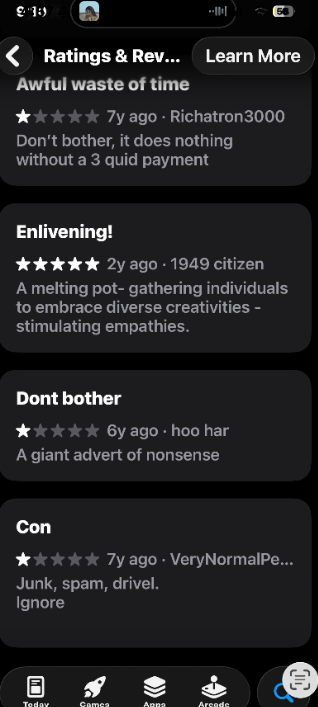
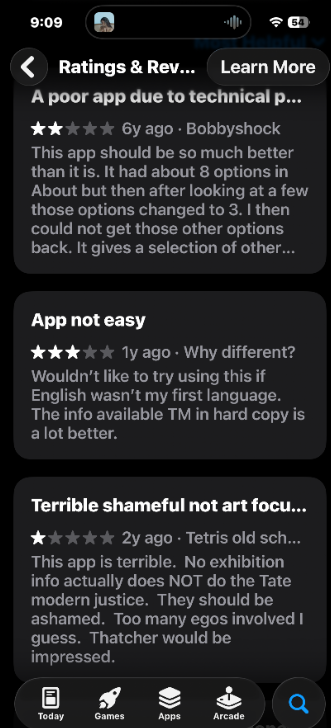
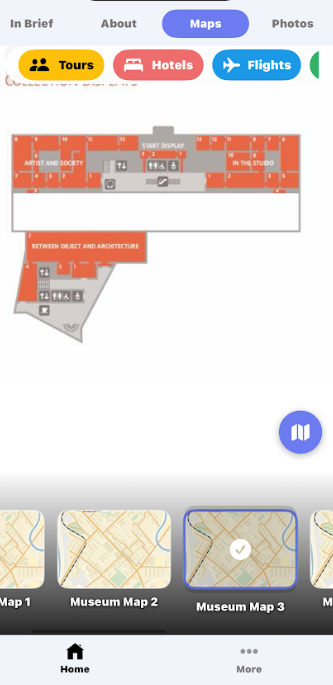
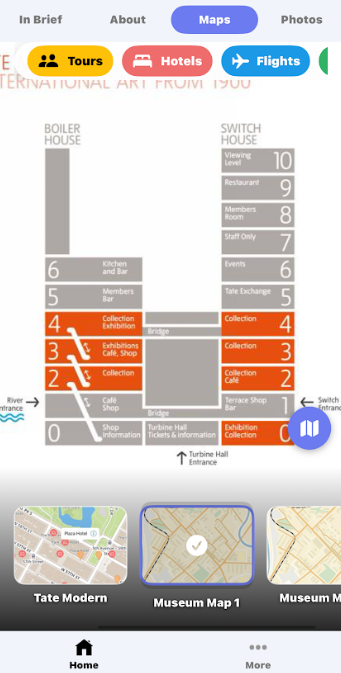
This gave me insight into real user experiences and common issues. I found that many visitors mentioned difficulty navigating large gallery spaces, unclear directions between exhibitions, and limited or hard-to-find information about artwork. Some reviews also highlighted that digital features were either lacking or not very helpful during visits, suggesting that there is an opportunity to improve how apps support users in real time. The maps are also not accessible as they do not show real time location which can mean that users can get frustrated by not fully understanding the navigation around the gallery itself.
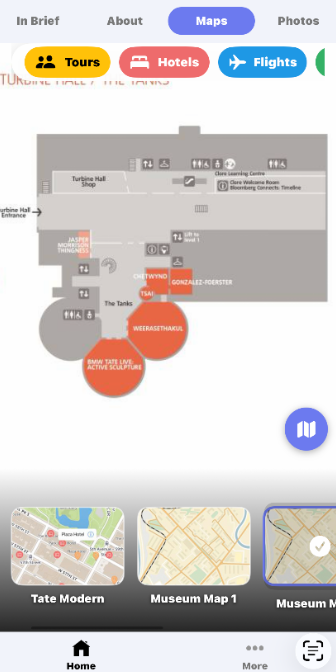
Based on this research, I identified my target audience as young adults, tourists, and creative individuals who are interested in mixed-media art. I found that these users are looking for a simple and engaging way to explore exhibitions, quickly access information, and navigate the gallery without confusion.
I also considered the stakeholders involved in the Urban Arts gallery, including gallery owners, curators, and artists. I understood that success for these stakeholders would involve attracting more visitors, increasing engagement with exhibitions, and effectively promoting artists. This means that the app needs to not only support users but also present artwork in a visually appealing and accessible way that will allow users to fully and effectively navigate the app.
From this, I identified key user needs, including easy navigation within the gallery, clear and accessible information about artwork and artists, access to events and exhibitions, and a visually engaging, modern interface that matches the aesthetic and style of the gallery itself to make the experience more immersive overall.
My research will directly influence my design decisions by encouraging a focus on simplicity, accessibility, and engagement. I will aim to create an app that prioritises clear navigation, interactive features, and a clean layout to ensure a positive and effective user experience for a wide audience.
Leave a Reply